What are the most important AI search numbers in 2026?

Why it matters
- 1.2 billion weekly active users: ChatGPT reached this figure on 10 November 2026, according to OpenAI product lead Adam Fry.[1]
- 2.5 billion monthly users: Google reported this figure for AI Overviews in its June 2026 investor presentation.[4]
- 8% versus 15%: Pew measured conventional-result clicks in 8% of Google visits with an AI summary and 15% without one.[2]
- 0.14% AI traffic share: Semrush reported this share in its 2025 analysis of 544.2 billion visits.[3]
- 770.7 million monthly referral visits: Similarweb estimated this worldwide average from June 2025 through May 2026, up 117.4% year over year.[8]
In this brief8 sections
The short answer
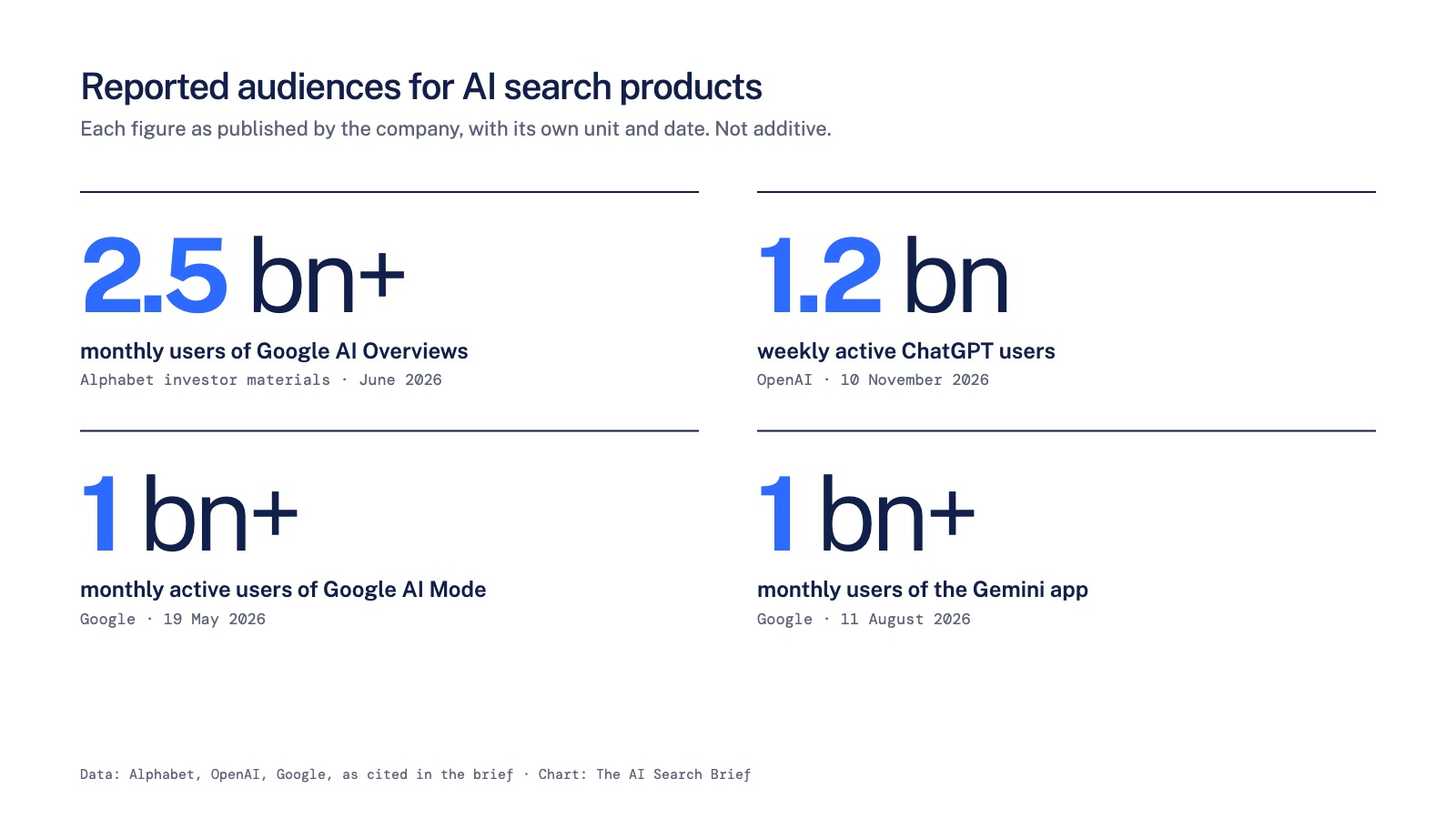
As of 17 November 2026, the biggest published audience number is Google AI Overviews at more than 2.5 billion monthly users, while ChatGPT reports 1.2 billion weekly active users and Google says AI Mode has more than 1 billion monthly active users.[1] These figures describe different products and time periods, so they should not be added together.
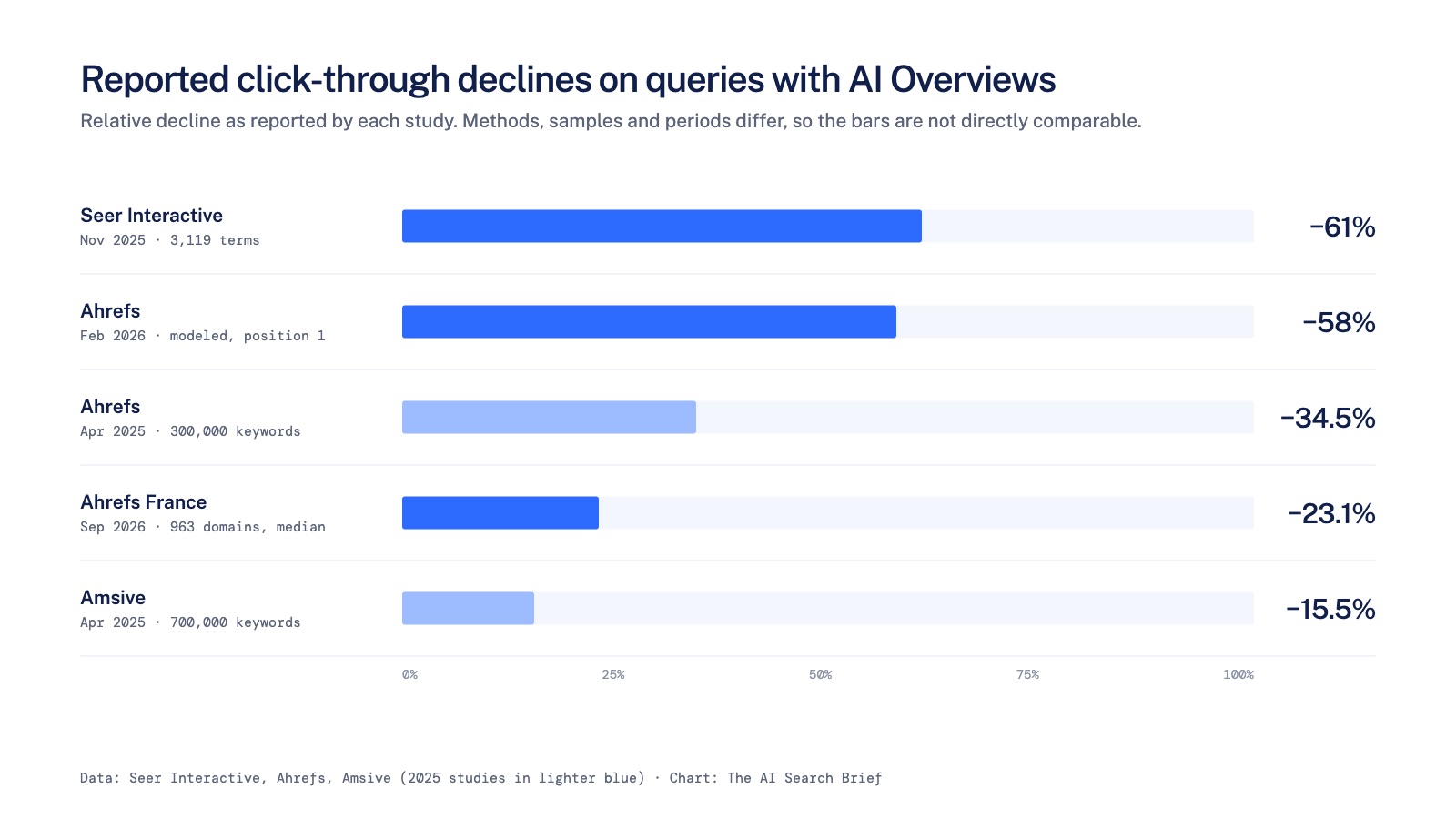
The more commercially useful numbers are smaller and more specific: Google users clicked a traditional result in 8% of visits when an AI summary appeared, versus 15% without one, while a separate 2026 study found a click on a source cited inside an Overview in about 1% of Overview visits.[2] AI referrals are growing, but Semrush measured them at 0.14% of total website traffic in its 2025 dataset.[3]
What happened
1.2 billion weekly active ChatGPT users — OpenAI product lead Adam Fry reported the figure on 10 November 2026.[1]
More than 1 billion monthly Gemini users — Google reported the figure on 11 August 2026 for the Gemini app, not for every Google AI product.[1]
More than 2.5 billion monthly AI Overviews users — Alphabet included the figure in its June 2026 investor presentation.[4]
More than 1 billion monthly active AI Mode users — Google reported the global figure on 19 May 2026.[5]
More than 100 million monthly Perplexity users — This figure was reported for April 2026 and attributed secondhand to the Financial Times and company executives.[6]
About 950 million monthly Claude website visits — Similarweb estimated visits to claude.ai from May 2026 onward; this is not a unique-user count.[7]
0.14% AI traffic share — Semrush’s analysis of 544.2 billion visits found that AI traffic represented 0.14% of total website traffic in its 2025 dataset.[3]
770.7 million monthly AI referral visits — Similarweb estimated the worldwide average from June 2025 through May 2026, up 117.4% year over year.[8]
138% year-over-year retail AI-traffic growth — Adobe reported that AI-driven retail traffic increased 138% in May 2026.[9]
54% higher AI-referred conversion — Adobe reported that AI-referred retail traffic converted 54% better than non-AI channels in the same analysis.[9]
More than 100,000 ChatGPT advertisers — OpenAI said more than 100,000 advertisers had used ChatGPT Ads by 21 October 2026; the figure is cumulative, not an active-advertiser count.[10]
Why it matters
Large user totals establish that AI search has become a mass-market distribution channel, but they do not show how often users click, buy or visit a publisher. Weekly active users, monthly users, website visits, referral visits and annualized revenue are different measurements.
The clearest evidence of search-result disruption concerns clicks. Pew found that users clicked a conventional search-result link in 8% of Google visits containing an AI summary, compared with 15% of visits without one.[2] That is a relative difference of 7 percentage points, but it is not a universal click-through rate for every query or website.
A separate 2026 preprint examined clicks on sources cited directly inside an AI Overview and found such a click in approximately 1% of Overview visits.[11] This measures a narrower action than Pew’s conventional-result click rate, so the two figures should not be compared as competing CTR benchmarks.
Referral traffic tells a similarly mixed story. Semrush’s 0.14% figure is an explicit share of total traffic in one large dataset, while Similarweb reports absolute monthly referral visits and Adobe reports growth and conversion outcomes in retail.[3] Together, the sources indicate rapid growth from a small measured base, not a single settled share of all web traffic.
Advertising is also moving beyond experimentation. OpenAI began testing ads in ChatGPT in the United States in February 2026 and later said that more than 100,000 advertisers had used the platform.[10][12] Google’s advertising documentation says sponsored placements can appear in AI Overviews and AI Mode.[13]
What we know and what is not confirmed
What is measured
- Audience reach: Google and OpenAI have published large user figures for AI Overviews, AI Mode, Gemini and ChatGPT.[14]
- Conventional search clicks: Pew compared Google visits with and without an AI summary.[2][11]
- Clicks on cited sources: A 2026 preprint measured clicks on links shown within AI Overviews.[11]
- Referral volume: Similarweb estimated monthly AI referral visits worldwide.[8]
- Traffic share: Semrush reported an AI traffic share within its own dataset.[3]
- Retail performance: Adobe reported AI-referral growth, conversion and engagement comparisons for retail.[9][15]
- Advertising adoption: OpenAI reported cumulative advertiser usage, while Google documents ad availability in AI-powered search experiences.[13]
What is not confirmed
A deduplicated total number of AI-search users — The published Google figures for AI Overviews and AI Mode do not establish that their audiences are unique or non-overlapping.[14]
A universal AI referral-traffic share for 2026 — Semrush provides a 0.14% share for its 2025 analysis, but Similarweb’s 770.7 million figure does not include an all-site denominator for an equivalent percentage.[3][8]
A comparable Claude user total — The reviewed sources provide an estimate of claude.ai visits, not a comparable monthly-active-user or weekly-active-user figure.[16]
A 2026 Perplexity query total — The widely reported figure of 780 million queries was for May 2025, not 2026.[6][17]
A universal AI Overview CTR — The 8% conventional-result click rate, the 15% comparison rate and the approximately 1% cited-source click rate measure different actions and populations.[2][11]
A ChatGPT-versus-Google advertising benchmark — The cited sources do not provide a directly comparable campaign CTR or return-on-investment figure for ChatGPT Ads and Google AI-search ads.[13][18]
Timeline
| Date | Development | Number or finding |
|---|---|---|
| 22 July 2025 | Pew published its AI-summary click analysis | 8% conventional-result clicks with a summary versus 15% without one.[2] |
| 5 June 2025 | Perplexity’s CEO reported a query figure | 780 million queries in the previous month; this is not a 2026 figure.[17][6] |
| 9 February 2026 | OpenAI began testing ChatGPT ads in the United States | Initial test launch; no campaign CTR was disclosed.[19] |
| 19 May 2026 | Google described AI Mode’s growth | More than 1 billion monthly active users globally.[5] |
| 11 June 2026 | Adobe reported retail AI-referral performance | AI-driven retail traffic was up 138% year over year in May; AI-referred conversion was 54% higher.[9] |
| June 2026 | Alphabet published investor materials | AI Overviews had more than 2.5 billion monthly users.[4] |
| 11 August 2026 | Google reported Gemini app usage | More than 1 billion monthly users.[20][17] |
| 3 September 2026 | Similarweb reported AI-referral volume | 770.7 million average monthly referral visits from June 2025 to May 2026, up 117.4% year over year.[8] |
| 21 October 2026 | OpenAI announced broader ChatGPT Ads availability | More than 100,000 advertisers had used ChatGPT Ads; expansion reached 26 new countries.[10] |
| 10 November 2026 | OpenAI product lead Adam Fry reported ChatGPT usage | 1.2 billion weekly active users.[20][1] |
| 17 November 2026 | Current reporting cutoff | Figures above remain dated measurements, not a single synchronized market total. |
Background: why AI-search numbers are difficult to compare
AI-search reporting combines several units that sound similar but answer different questions. A weekly active-user figure counts people active during a week; a monthly user figure covers a month; website visits count sessions or visits to a domain; referral visits count traffic sent from an AI platform to another site; and annualized revenue run rate extrapolates a current pace rather than reporting recognized revenue.
Product boundaries also differ. Google’s AI Overviews and AI Mode are search experiences, while the Gemini figure cited here concerns the Gemini app.[13] ChatGPT’s weekly active-user figure covers the product rather than a separately defined search-only audience.[21][1] Claude’s reported figure is a website-visit estimate, and Perplexity’s published numbers have referred at different times to users, queries and search or agent tools.[6]
Click studies also use different denominators. Pew measured clicks on traditional search-result links during Google visits with or without an AI summary.[2] The 2026 preprint measured clicks on sources cited inside an Overview.[11] Neither should be treated as a complete measure of organic visibility, assisted conversions or brand influence.
What should marketers track next?
The most useful measurement framework separates reach, visibility, referral and commercial outcomes.
- Track audience reach separately by product. Record ChatGPT weekly active users, Gemini monthly users, AI Overviews monthly users and AI Mode monthly active users in separate fields.
- Track AI-answer visibility. Measure whether a brand is mentioned, which sources are cited and how prominently the brand appears.
- Track referral sessions. Use analytics data to identify visits arriving from ChatGPT, Perplexity, Gemini and other AI platforms.
- Track assisted outcomes. Compare conversions, revenue and engagement for AI-referred sessions rather than relying on traffic volume alone.
- Track conventional and cited-source clicks separately. A click on a standard search result is not the same event as a click on a source cited within an AI Overview.
- Track advertising with its exact qualifier. Distinguish tests, available placements, cumulative advertisers, active advertisers, impressions, clicks and revenue.
This approach avoids turning incompatible figures into a misleading market-size total. It also makes the reporting more useful for decisions about content, search visibility, referral measurement and paid acquisition.
Frequently asked questions
How many weekly users does ChatGPT have in 2026?
ChatGPT had 1.2 billion weekly active users according to a statement from OpenAI product lead Adam Fry on 10 November 2026.[1] The figure covers weekly active users of ChatGPT and should not be interpreted as a count of ChatGPT search queries.
What is the click-through rate for Google AI Overviews?
There is no single universal AI Overview click-through rate in the cited evidence. Pew found conventional search-result clicks in 8% of visits with an AI summary versus 15% without one, while a separate 2026 study found a click on an Overview-cited source in about 1% of Overview visits.[2][11] Those measurements use different click definitions.
What share of website traffic comes from AI referrals?
Semrush reported that AI traffic represented 0.14% of total website traffic in its 2025 analysis of 544.2 billion visits.[3] Similarweb instead reported an average of 770.7 million AI referral visits per month worldwide from June 2025 to May 2026, without providing a comparable all-site denominator.[8]
How many people use Google AI Overviews?
Google’s parent company reported more than 2.5 billion monthly users for AI Overviews in June 2026.[4][6] The figure is separate from Google’s more than 1 billion monthly active users for AI Mode, and the sources do not establish whether those audiences overlap.[1][20]
Are AI referrals more valuable than traditional search referrals?
Adobe reported that AI-referred retail traffic had 54% higher conversion and 15% higher engagement than non-AI channels in its June 2026 analysis.[9] That evidence is specific to Adobe’s retail analysis and does not establish that AI referrals outperform traditional search in every industry.
Sources
- 1ChatGPT reaches 1.2 billion weekly users after adding 200 million in two months, OpenAI product lead says - AI Brief — dailyaibrief.com
- 2Do people click on links in Google AI summaries? | Pew Research Center — pewresearch.org
- 3We analyzed billions of web visits: How AI is reshaping traffic channels — semrush.com
- 4Alphabet investor presentation: June 2026 — blog.google
- 5How AI Mode is changing and expanding the way people search — blog.google
- 6Perplexity AI statistics report, November 2026 | Rhino Rank — rhinorank.io
- 7Similarweb Anthropic IPO Primer — similarweb.com
- 8AI Referral Traffic by Industry: 2026 Data | Similarweb — aisearch.similarweb.com
- 9Q3 AI Traffic Trends Report — business.adobe.com
- 10ChatGPT Ads expands to 26 new countries as over 100,000 advertisers have used the platform | OpenAI — openai.com
- 11Investigating Click Behaviors On Google Search Result Pages That Produce an AI Overview — arxiv.org
- 12ChatGPT Ads expands across Europe | OpenAI — openai.com
- 13About ads in AI-powered experiences in Google Search - Google Ads Help — support.google.com
- 14AI in Search Reduces Publisher Referrals Without Improving User Experience: Experimental Evidence — arxiv.org
- 15AI Traffic Trends Report — business.adobe.com
- 16Claude Users and Statistics 2026: 50+ Numbers With Sources — babylovegrowth.ai
- 17Perplexity AI Monthly Queries: Verified 2026 Data — perplexityaimagazine.com
- 18Building advertising for the way people use AI | OpenAI — openai.com
- 19Testing ads in ChatGPT | OpenAI — openai.com
- 20Anthropic raises $30B Series G at $380B valuation \ Anthropic — anthropic.com
- 21AI Search Stats in 2026 | Similarweb — similarweb.com