What happened in AI search this week (November 10-16, 2026)?

Why it matters
- Google said Gemini 4 Hydrogen became globally available in Search on November 12, with AI Mode improvements for complex prompts, query fan-out, richer links, structured answers, and comparison tables.[2][3]
- Bing introduced preview controls that let users turn AI answers off across searches or use the
-aioperator.[10] - OpenAI announced ChatGPT business profiles, product feeds, Business Agents, and a Wallet feature with user approval required for purchases.[13]
- ChatGPT Ads added reported bidding and targeting controls, while Aleph became the exclusive reseller in 44 countries.[14]
- Perplexity launched Monitor API for scheduled updates and announced Frontier Research as an autonomous-research initiative.[4]
In this brief6 sections
AI search news this week centered on richer Google AI answers, more user control over AI results, and the expansion of ChatGPT and Perplexity into business discovery, advertising, payments, and monitoring. The most significant developments from November 10-16 were Google’s Gemini 4 Hydrogen rollout in Search, Bing’s AI-answer opt-out controls, OpenAI’s business and commerce features, and Perplexity’s new monitoring and autonomous-research initiatives.[1]
What happened
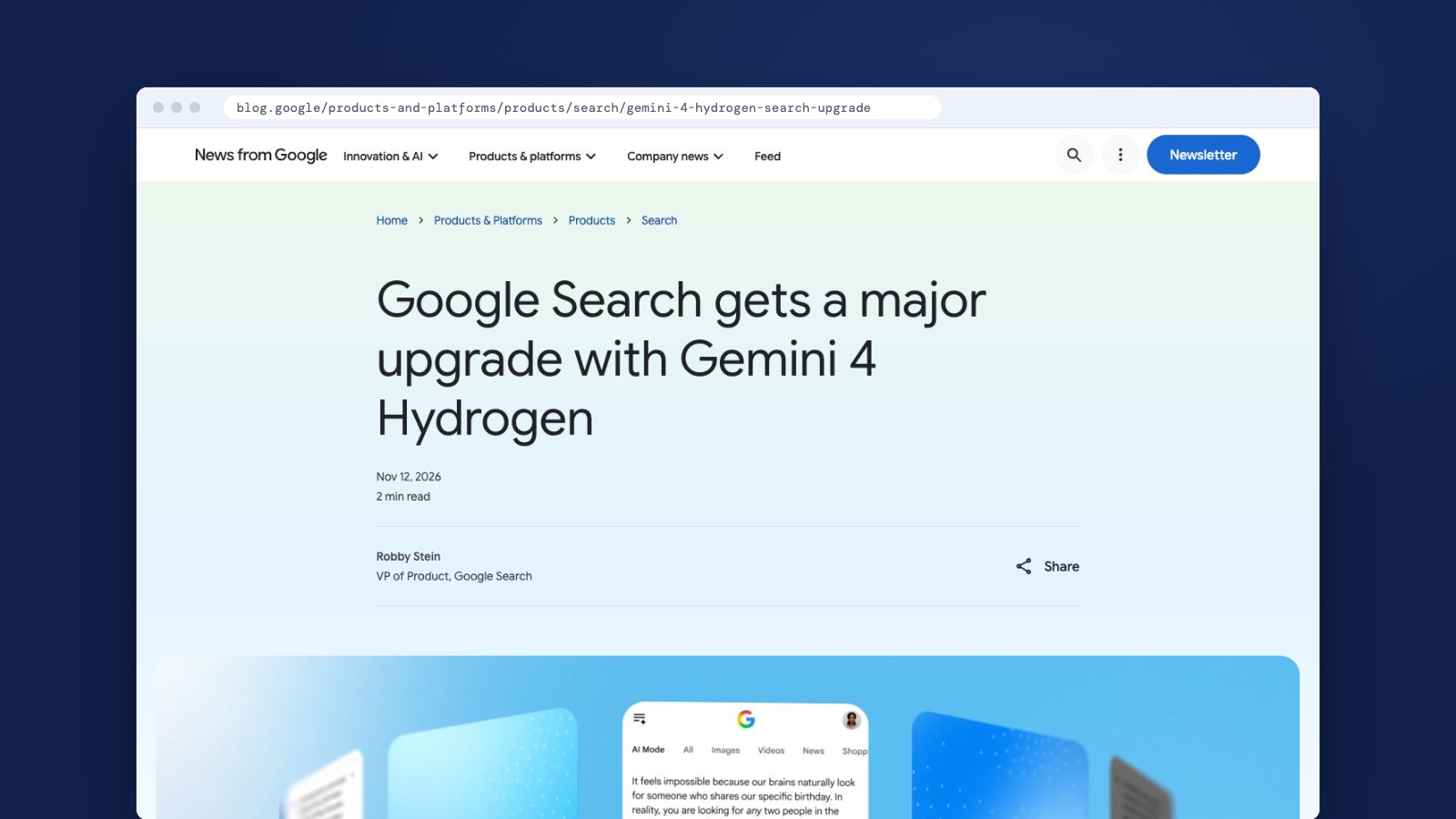
Google brings Gemini 4 Hydrogen to Search. On November 12, Google announced that Gemini 4 Hydrogen was globally available in Search, including AI Mode features for more nuanced and multipart prompts, query fan-out, richer links, images, structured answers, comparison tables, custom tools, and improved language understanding.[2] Coverage also described the update as an effort to improve answers to complicated questions.[3]
Why it matters: Google is positioning AI Mode as a broader research interface rather than a feature limited to short question-and-answer exchanges. The addition of comparison tables, structured answers, and query fan-out suggests that complex searches are becoming a central product use case.[3][2]
What we know / what is not confirmed: Google’s announcement confirms the global availability of Hydrogen in Search and lists the product capabilities. The available reporting does not establish that every listed capability appears identically for every user, query, language, or market.[4]
Google expands definition answers and tests image generation in AI Overviews. Search Engine Roundtable reported on November 12 that fuller definition-style AI Overviews had expanded by default.[5] On November 13, the publication reported that image generation had returned for some searchers.[6]
Why it matters: More complete definitions place explanatory content directly inside the search results, while image generation could add a new generative format to Google’s answer panel.[7][8]
What we know / what is not confirmed: The image-generation report described availability for some users, not a confirmed general rollout.[6] The research report does not establish the size of the test, its geographic scope, or whether the feature remained available after the reported observation.
Google tests sponsored results below AI Overviews. Search Engine Watch reported on November 16 that Google was testing sponsored placements below AI Overviews.[9]
Why it matters: If this placement develops beyond testing, paid search inventory could appear immediately alongside AI-generated answers, creating a new relationship between commercial results and generated summaries.
What we know / what is not confirmed: The report describes a test only. It is not evidence that sponsored results below AI Overviews have been generally launched or are available to all advertisers.[9]
Bing adds controls to turn AI answers off. Microsoft announced on November 11 a preview of Bing AI Search Choice, a Chrome and Edge extension with a toggle that applies across Bing searches.[10] Microsoft also introduced the -ai operator for suppressing AI answers.[10]
Why it matters: Bing is giving users a direct choice between an AI-assisted search experience and conventional results. That makes answer suppression an explicit product control rather than an informal workaround.[11][12]
What we know / what is not confirmed: Microsoft’s announcement covers the preview extension and the -ai operator. The available source does not establish when the feature will leave preview or whether equivalent controls will appear in every Bing interface.[10]
OpenAI adds business profiles and agents to ChatGPT. OpenAI announced Businesses in ChatGPT beta on November 10.[7][11] Eligible businesses can claim and update profiles, add product feeds with prices and availability, view mentions and website clicks, and build Business Agents.[11] Initial eligibility was described as covering U.S. e-commerce and online-service businesses.
Why it matters: ChatGPT is becoming a managed discovery channel for businesses and products. Profiles, product feeds, mentions, clicks, and agents give companies ways to represent information inside an AI-mediated product-discovery journey.[11][7]
What we know / what is not confirmed: The announcement identifies the beta, its capabilities, and the initial business eligibility described by OpenAI.[7] The available reporting does not confirm a wider international rollout, universal access, or performance results for participating businesses.[13]
ChatGPT introduces Wallet for user-approved agent payments. OpenAI announced ChatGPT Wallet on November 13.[13] The system uses payment tokens instead of sharing a user’s actual card details and requires a security check for each purchase.[13] Initial access was limited to eligible U.S. ChatGPT Pro subscribers aged 18 and older.[13]
Why it matters: Wallet connects conversational product discovery with a controlled checkout step. The required security check preserves an explicit user approval point while allowing an agent to assist with purchasing.[13]
What we know / what is not confirmed: OpenAI’s announcement confirms the payment-token design, purchase security check, and initial eligibility criteria.[13] The available source does not establish the full set of supported merchants, products, payment methods, or international availability.
ChatGPT Ads adds bidding controls and expands reseller support. On November 12, OpenAI announced that Aleph would be the exclusive reseller for ChatGPT Ads in 44 countries, providing local invoicing and support.[14] Search Engine Land reported that ChatGPT Ads added Target CPA and Target CPC bidding, more granular geographic targeting, and flexible product filters.[12]
Why it matters: Advertisers receive more familiar campaign controls and a route to local buying support as ChatGPT Ads expands internationally. The changes also move ChatGPT advertising closer to the operational model used by established performance-marketing platforms.[12][7]
What we know / what is not confirmed: The sources confirm the 44-country reseller arrangement and the reported campaign-control changes.[10][5] The research report includes no performance benchmarks demonstrating that the new controls improve conversion rates, return on ad spend, or campaign efficiency.[12]
Perplexity launches Monitor API and announces Frontier Research. Perplexity announced Monitor API on November 16 for tracking topics or pages on a schedule and sending relevant updates by webhook.[4] The company also announced Frontier Research, an autonomous-research initiative backed by more than 10,000 GPUs.[15]
Why it matters: Monitor API extends search from one-time answers into recurring change detection, while Frontier Research signals an effort to apply AI systems to longer-running research workflows.[4]
What we know / what is not confirmed: The announcements establish the Monitor API’s scheduled monitoring and webhook functions, as well as Frontier Research’s stated GPU backing.[4] They do not establish the initiative’s final product scope, general availability, research performance, or commercial launch timetable.
Why it matters
This week’s developments show three overlapping directions in AI search.
First, answer formats are becoming more structured and multimodal. Google’s Hydrogen update includes comparison tables, structured answers, images, richer links, and query fan-out, while definition answers and a limited image-generation test add further content directly to the results page.[2]
Second, AI search is becoming more controllable. Bing’s AI Search Choice and -ai operator give users ways to suppress AI answers, while ChatGPT Wallet adds a security check before an agent-assisted purchase.[13] These controls address two distinct concerns: whether a user wants an AI-generated result and whether an agent may complete a transaction.
Third, AI search is moving closer to business infrastructure. ChatGPT business profiles and product feeds create a managed presence for companies, ChatGPT Ads adds campaign controls, and Perplexity Monitor API makes recurring search-based monitoring available through webhooks.[4]
For publishers and brands, the practical consequence is that visibility is no longer limited to whether a page appears in a traditional result. Businesses may need to consider how products, profiles, cited pages, advertising placements, and recurring monitoring systems represent them across different AI interfaces. The reported developments establish the product changes, but they do not yet provide evidence about traffic, rankings, conversions, or long-term market share.[12]
What we know and what is not confirmed
The clearest confirmed launches this week came from official announcements: Google’s Gemini 4 Hydrogen Search update, Microsoft’s Bing controls, OpenAI’s Businesses in ChatGPT and Wallet announcements, OpenAI’s ChatGPT Ads reseller announcement, and Perplexity’s Monitor API and Frontier Research announcements.
Several other developments remain tests, previews, or limited releases. Google’s sponsored placements below AI Overviews were reported as a test, image generation in AI Overviews was observed for some searchers, and Bing AI Search Choice was announced as a preview.[6]
The available coverage does not establish that the reported features are available in every country, language, account type, device, or query context. It also does not provide independent performance data for the new advertising controls, business profiles, wallet functionality, or monitoring API.[12]
Anthropic did not publish a search-specific update in the official product-update sources reviewed for this week. Its dated November 10-12 entries concerned Managed Agents, app integrations, meetings, manufacturing, and productivity tools rather than a search feature.[16]
Dated timeline
| Date | Development | Status or qualification |
|---|---|---|
| November 10, 2026 | OpenAI announced Businesses in ChatGPT beta.[11][7] | Initial eligibility focused on U.S. e-commerce and online-service businesses.[7] |
| November 11, 2026 | Microsoft announced Bing AI Search Choice and the -ai operator.[10] |
AI Search Choice was in preview.[10] |
| November 12, 2026 | Google announced Gemini 4 Hydrogen in Search.[6] | Google described global availability in Search.[3][5] |
| November 12, 2026 | Google definition Overviews were reported as expanding by default.[5] | Reported by Search Engine Roundtable.[5] |
| November 12, 2026 | OpenAI announced Aleph as ChatGPT Ads reseller in 44 countries.[14] | Local invoicing and support were included in the announcement.[14] |
| November 12, 2026 | Search Engine Land reported new ChatGPT Ads bidding and targeting controls.[12] | The report did not provide performance benchmarks.[12] |
| November 13, 2026 | Image generation in AI Overviews was reported for some searchers.[6] | Limited or user-specific availability was reported.[13] |
| November 13, 2026 | OpenAI announced ChatGPT Wallet.[13] | Initial access was limited to eligible U.S. Pro subscribers aged 18 and older.[13] |
| November 16, 2026 | Google sponsored placements below AI Overviews were reported as a test.[9] | No general rollout was confirmed.[6][5] |
| November 16, 2026 | Perplexity announced Monitor API and Frontier Research.[4] | Monitor API supports scheduled monitoring and webhooks; Frontier Research was announced as an initiative.[4] |
Background: how AI search developments differ from traditional search updates
Traditional search updates generally change ranking systems, result formats, crawling, or advertising placements. AI search updates can change those elements while also changing how a system interprets a prompt, expands it into sub-queries, selects sources, synthesizes an answer, and presents links or products.
Google’s Hydrogen announcement explicitly refers to query fan-out, structured answers, comparison tables, and richer links, illustrating how one prompt can produce a more assembled response than a conventional list of results.[2] OpenAI’s business-profile and product-feed features address how companies are represented inside an answer-driven interface, while Perplexity’s Monitor API applies search to recurring information needs rather than a single query.[4]
These differences mean that a product announcement can affect several layers at once: the user interface, the answer-generation process, the source-selection system, advertising, commerce, or ongoing monitoring. The announcements in this brief confirm product direction and availability statements, but they do not by themselves prove changes in organic visibility or business performance.[13]
Frequently asked questions
What was the biggest AI search news this week?
Google’s Gemini 4 Hydrogen rollout in Search was the broadest search-interface development reported during November 10-16.[6] Google said the update improved handling of complex prompts and added richer answer formats, including structured answers and comparison tables.[2][1]
What happened with Google AI Mode in November 2026?
Google announced that Gemini 4 Hydrogen was globally available in Search and described improvements to AI Mode, including query fan-out, richer links, images, structured answers, comparison tables, custom tools, and language understanding.[2] The available sources do not establish that every capability is available to every user or query.[13][10]
Did Google launch ads below AI Overviews?
No general launch was confirmed. Search Engine Watch reported on November 16 that Google was testing sponsored placements below AI Overviews, so the development should be treated as a test rather than a completed rollout.[9]
What changed in ChatGPT search and shopping this week?
OpenAI announced business profiles and Business Agents, while ChatGPT Wallet added user-approved agent payments for an initially limited group of eligible U.S. Pro subscribers. OpenAI also expanded ChatGPT Ads reseller support to 44 countries, and Search Engine Land reported new Target CPA, Target CPC, geographic-targeting, and product-filter controls.[14][12]
Did Perplexity launch a new search product?
Perplexity announced Monitor API, which tracks topics or pages on a schedule and sends relevant updates through webhooks.[4] It also announced Frontier Research, an autonomous-research initiative backed by more than 10,000 GPUs.[15] The announcements do not establish the final scope or commercial availability of Frontier Research.[15][17]
Sources
- 1Google’s new Gemini model is better at understanding complicated questions | The Verge — theverge.com
- 2Google Search upgrade: Gemini 4 Hydrogen features — blog.google
- 3Google's latest Search upgrade promises better answers to your most complicated questions | TechCrunch — techcrunch.com
- 4Introducing Perplexity’s Monitor API — perplexity.ai
- 5Daily Search Forum Recap: November 12, 2026 — seroundtable.com
- 6Daily Search Forum Recap: November 13, 2026 — seroundtable.com
- 7OpenAI rolls out new business profiles, making ChatGPT just a little bit more like Google | TechCrunch — techcrunch.com
- 8Answer Bubbles: Information Exposure in AI-Mediated Search - ACL Anthology — aclanthology.org
- 9Google tests sponsored results below AI Overviews — searchenginewatch.com
- 10Your Choice Turn Ai Answers On Or Off In Bing — blogs.bing.com
- 11Introducing Businesses in ChatGPT | OpenAI — openai.com
- 12ChatGPT Ads adds Target CPA and CPC bidding, expands product campaign controls — searchengineland.com
- 13Introducing ChatGPT Wallet | OpenAI — openai.com
- 14ChatGPT Ads increases its market presence in 44 countries | OpenAI — openai.com
- 15Introducing Perplexity Frontier Research — perplexity.ai
- 16Claude Platform release notes — platform.claude.com
- 17Perplexity Blog — perplexity.ai